Stay connected with BizTech Community—follow us on Instagram and Facebook for the latest news and reviews delivered straight to you.
The surge in funding for World Labs marks another defining moment in the evolution of artificial intelligence, emphasising how investor attention is shifting from text-based systems towards machines that can understand and interact with the physical world.

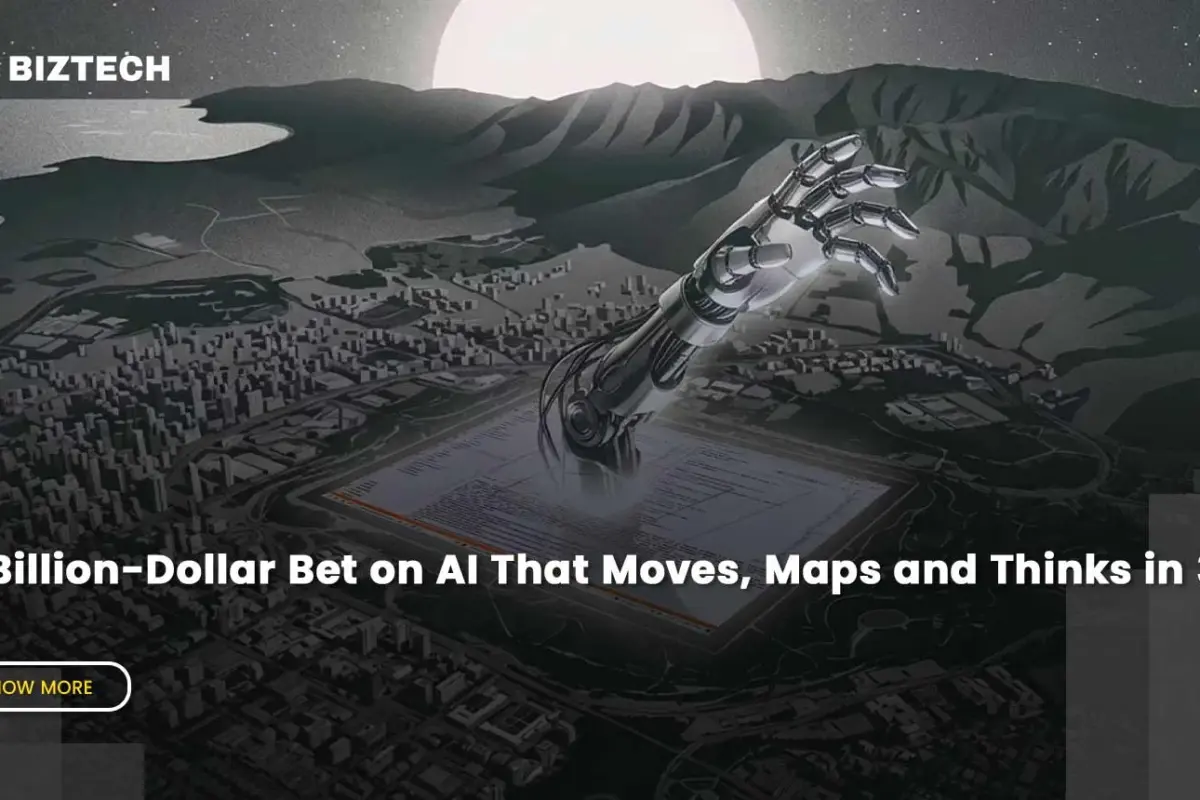
Founded by Fei-Fei Li, World Labs has raised $1 billion in new capital, boosting its valuation to over $5 billion. The funding round features major backers such as Andreessen Horowitz, New Enterprise Associates, and Radical Ventures—highlighting ongoing confidence in next-generation AI infrastructure despite turbulence in global technology markets.
A Shift from Language to the Physical World
Li, widely recognised for her seminal contributions to computer vision, is best known for creating ImageNet, the dataset that catalysed the deep learning revolution in 2012. After leaving Stanford University in 2025, she launched World Labs with an ambitious aim: building “spatial intelligence” systems capable of reasoning in three-dimensional environments.
Unlike large language models that process text or generate images, spatial AI aims to give machines a practical understanding of geometry, movement, and physical interaction. The implications go well beyond chatbots. From robotics and augmented reality to autonomous drones and digital twins for urban design, the goal is to create AI systems that can plan, adapt, and carry out actions in ever-changing real-world environments.
In practical terms, early demonstrations reportedly showcased AI models capable of planning robot navigation through cluttered environments with high accuracy—an advance that, if scalable, could transform manufacturing floors, warehouses, and even surgical robotics.
Strategic Timing in a Heated Investment Climate
The $1 billion investment occurs amid a wider surge in AI capital flows. Global investment in the sector exceeded $150 billion in 2025, even as concerns about an “AI bubble” have become more vocal in financial circles. The International Monetary Fund has warned that parts of the AI ecosystem may be overvalued, especially where revenue models remain speculative.
World Labs’ strategy seems tailored to address such concerns. By concentrating on applied research with evident industrial applications, it aims to stand out from ventures mainly driven by hype around generative systems. Investors are effectively supporting Li’s long-term vision—betting that foundational innovation in spatial reasoning will drive the next wave of commercially viable AI tools.
The firm also plans to collaborate with hardware manufacturers, possibly integrating its models with cutting-edge chips from companies like Nvidia and Qualcomm. Such alliances could be crucial, given the high computational demands of training and deploying three-dimensional AI systems.
Geopolitics, Ethics and Environmental Costs
World Labs’ rise also intersects with broader geopolitical forces. As a Chinese-born scientist working in the United States, Li has long promoted open scientific exchange. However, tightening export controls and US–China tensions mean that AI innovation now occurs within a more scrutinised strategic environment.

Beyond geopolitics, spatial AI raises new ethical issues. Systems that map and interpret physical spaces evoke valid concerns about privacy and surveillance. The environmental impact of training large-scale models—already under scrutiny—may worsen as spatial datasets become more complex. The company has committed to carbon-neutral operations and transparent safety evaluations, though fulfilling these promises will be closely monitored.
The Road Ahead
The coming months will assess whether World Labs can turn its vision into practical platforms. Its initial spatial AI models are anticipated by mid-2026. Success would mark a significant shift in AI’s development—from merely generating content to perceiving and acting within the real world.
For investors, the focus is on leadership and long-term value creation. For the wider industry, the message is clear: the next frontier lies not only in language, but also in teaching machines to navigate the geometry, unpredictability, and constraints of physical space.
Read Also: Amazon Forecasts $200 Billion Capex Surge in 2026 for AI Infrastructure