Stay connected with BizTech Community—follow us on Instagram and Facebook for the latest news and reviews delivered straight to you.
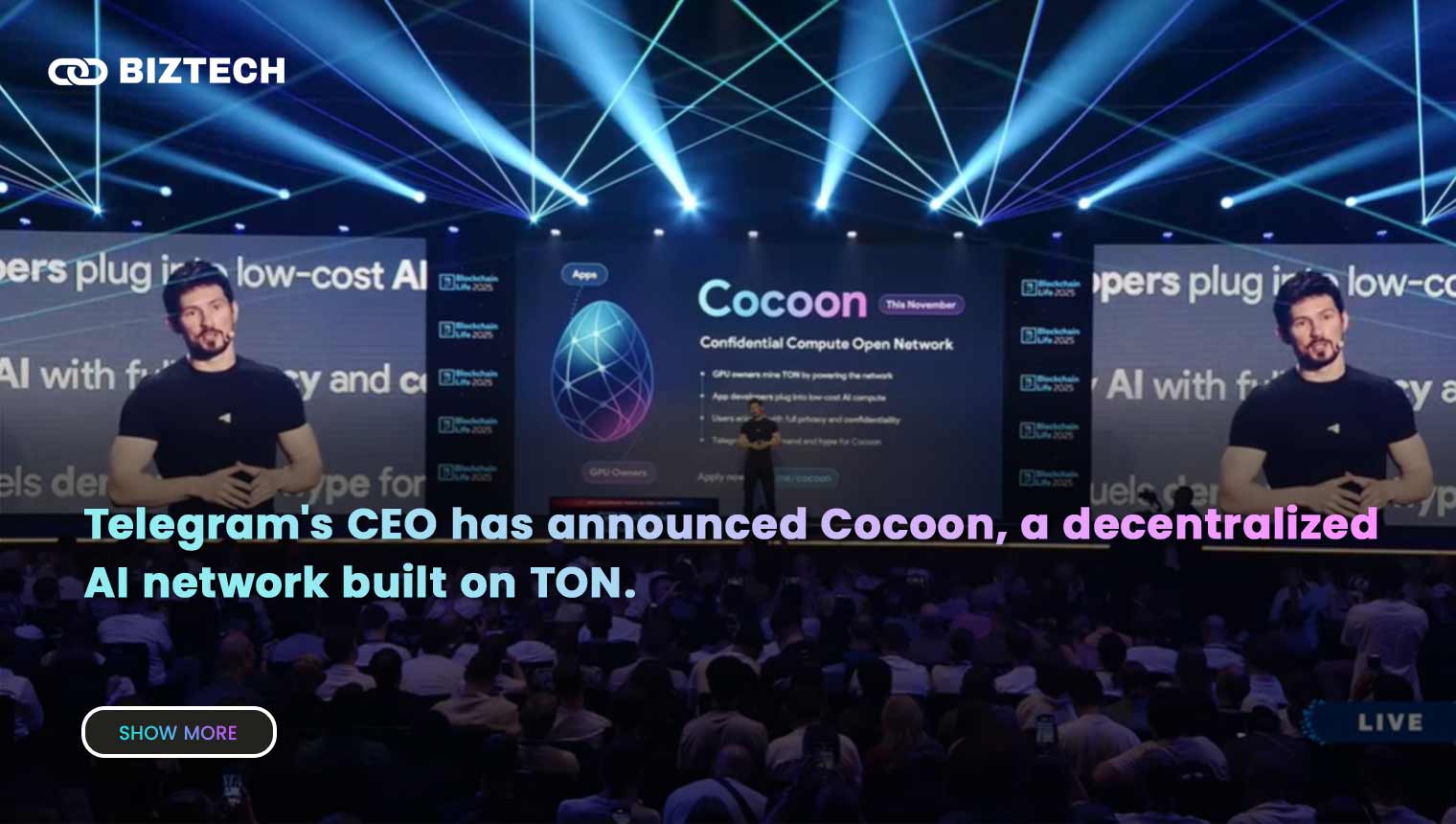
Telegram CEO Pavel Durov has announced Cocoon, a decentralized AI compute network built on The Open Network (TON) blockchain. This is a radical mix of messaging, blockchain, and AI.
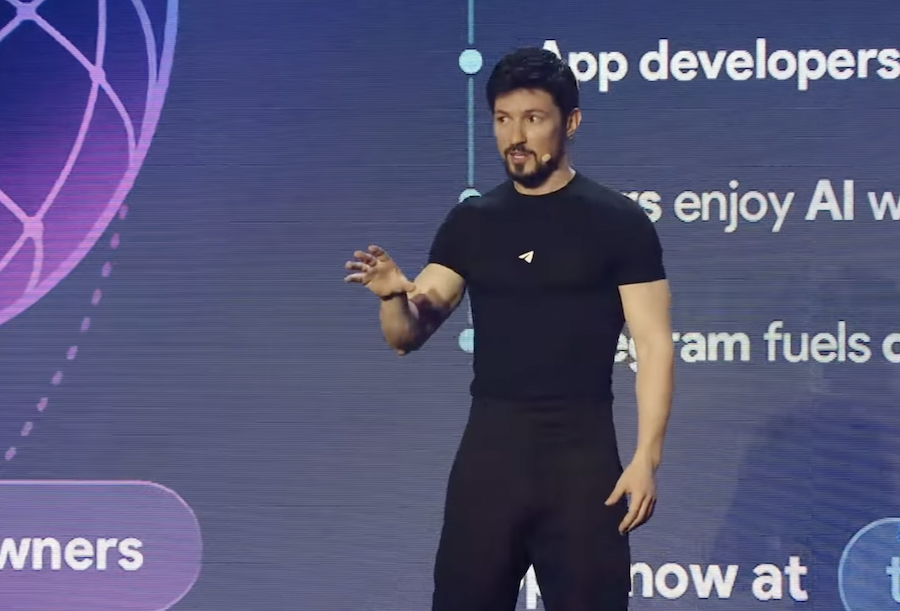
At the Blockchain Life 2025 conference in Dubai on October 29, 2025, the announcement of Cocoon, which stands for Confidential Compute Open Network, was made. The goal of Cocoon is to give users access to AI tools without having to give their data to big companies like OpenAI or Google.
In exchange, GPU owners will get Toncoin for contributing processing power. This privacy-first platform, which will be available to the public in November 2025, will make Telegram’s 950 million users early adopters through Mini Apps and bots. This is Durov’s latest attack against the loss of digital freedoms. Cocoon’s on-chain verification and encrypted compute could make the $500 billion AI market more accessible to everyone, but it will be hard to scale decentralized inference in TON’s ecosystem of 1 billion users.
Blockchain AI that puts privacy first
Durov’s speech at Blockchain Life called Cocoon a “perilous shift” in the growth of blockchain, from simple ledgers to the backbone of AI. He said, “For the last 20 years, we’ve been slowly losing our digital freedoms,” and he pointed to how centralized AI takes in suggestions, patterns, and metadata for training that isn’t clear. Cocoon counters this via private computing: Data stays encrypted while the GPU works on it, so only the requesters can see it. TON’s sharded architecture makes sure that records on-chain can’t be changed.
Users give up unused GPU power—either from data centers or their own computers—and get TON ($2.17 as on October 30, 2025) for things like chatbots and image generation. Developers use cheap, censorship-resistant computing and pay in TON for AI on demand without being locked into a provider. The first client, Telegram, will use Cocoon in Mini Apps for private questions, taking use of its 1 billion MAUs to grow quickly. Durov said, “Cocoon is private AI on TON,” which is in line with Telegram’s focus on privacy since 2013.
The network’s multi-chain design works with Ethereum and Solana and employs zero-knowledge proofs to make sure that outputs are correct without revealing any data. This solves problems with AI in 2025, such OpenAI’s use of training data without permission. Durov said on a Lex Fridman podcast, “Decentralization isn’t just for money; it’s for people to have control over AI.”
Fighting Control from one place
The fact that OpenAI is worth $157 billion and Google’s Bard ecosystem is worth $2 trillion has prompted to a reaction against centralized AI: 70% of consumers are worried about data being misused (Pew 2025), and biases in models like GPT-4 keep inequities going. Cocoon “resists” by using market-driven pricing: GPU providers compete with each other to lower costs by 50% below AWS, and TON’s consensus stops single-point failures.
This adds to TON’s momentum: The Telegram Open Network split in 2021 was worth $1.6 billion. By 2025, the TVL will be worth $20 billion. TON handles 500 million transactions every day, which is what caused DOGS memecoin to rise by $1 billion. Cocoon goes much further with AI: GPU staking pays 5–10% APY in TON, which encourages supply, while private enclaves like Intel SGX protect data. Durov’s goal is “a shared system where users give and get, not feed corporate machines.”
Some people are worried about how scalable it is: TON’s 100,000 TPS can handle payments, but AI inference needs petascale FLOPs. Early testing on 1,000 GPUs hit 1,000 queries/second, but corporate loads could be too much for it. It’s possible that hybrid scaling will happen with Render Network and Ankr, but the high energy costs (GPUs use 300W or more) raise concerns about sustainability in a world after the Paris Accord.
Integration with Telegram: 950 Million Users as a Launchpad
With 950 million active users every month, Telegram is the right place for Cocoon to test its ideas: Mini Apps, which now have 500 million daily active users, will add AI bots for private chats. For example, they might use encrypted picture generation or sentiment analysis without OpenAI relays. Durov said that “Telegram will be Cocoon’s first major client.” He said this while investing in promotion and proving the network’s worth through on-chain proofs.
This comes after TON’s successes: The NOT currency airdrop to 30 million users in 2024 caused $500 million in volume, and Gifts’ NFT integration got 100 million claims. Cocoon could be better than this: Labs says that donations of GPU from Telegram’s 1 million+ developers might help start 10,000 nodes by the first quarter of 2026. Durov’s X post, “Private AI on TON—because the world needs decentralized freedom,” got 200,000 likes.
Telegram has 500 million users in Asia, so Cocoon may shake up centralized AI like Baidu Ernie by paying TON prizes for regional computation. This would fit with China’s $100 billion AI spending and avoid PBOC oversight because TON is based abroad.
Problems and effects over the world
Privacy and verifiability are two things that make decentralized AI appealing, but they also confront problems: Confidential computation is 20% slower than centralized compute, plus TON’s sharding constraints (finality in less than a second, but only 1,000 nodes) mean that enhancements are needed.
There are signs of regulatory headwinds: The EU’s AI Act requires openness, and the SEC in the US sees tokenized computations as securities. Durov’s “perilous shift” could cause problems if attacks show weaknesses in encrypted data.
Cocoon increases TON’s $20 billion TVL over the world by combining AI’s $500 billion market with blockchain’s $4 trillion industry. According to McKinsey, this may create a $100 billion subsector by 2030. For Web3, it’s proof: From decentralized research (DeSci) to AI oracles, TON might be the leader, but how well it works is what matters.
Conclusion
Pavel Durov’s Cocoon, which was shown off at Blockchain Life 2025, brings decentralized AI to TON. It gives GPU owners TON for private inference and protects 950 million Telegram users from Big Tech’s data thirst. It combines privacy and scale with secret computing and Mini App connections. It will launch in November 2025 as a “perilous shift” in the evolution of blockchain. Connections to TON’s $20 billion ecosystem promise $100 billion in potential, but scalability and regulations are problems. Durov doesn’t want things to be centralized, thus Cocoon could change the way AI works with cryptocurrency. Keep an eye on Q1 2026 for signs of adoption.