Stay connected with BizTech Community—follow us on Instagram and Facebook for the latest news and reviews delivered straight to you.
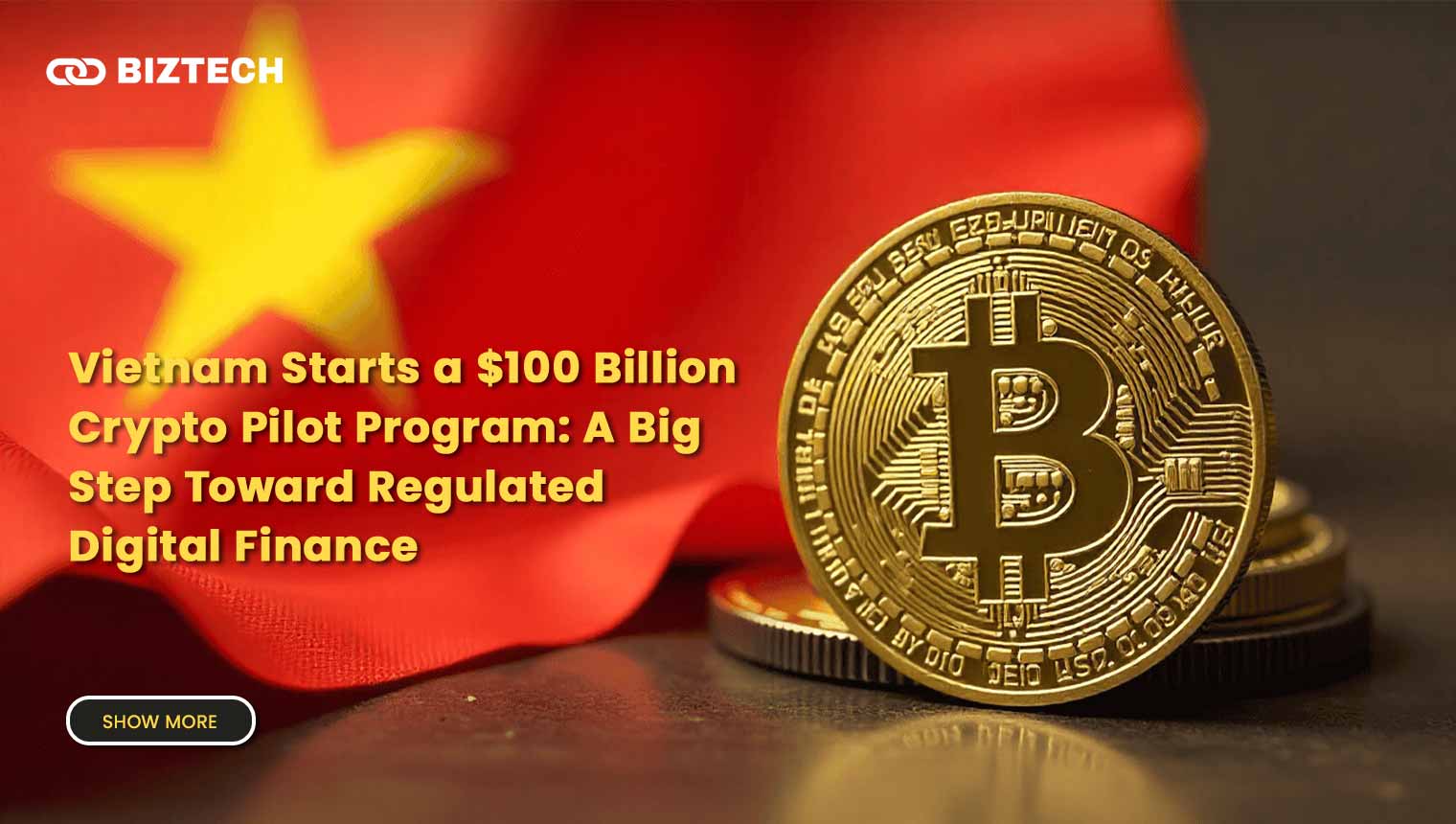
Vietnam is about to change its place in the global cryptocurrency market with the start of an unprecedented five-year pilot program that aims to regulate and domesticate a trading sector worth more than $100 billion a year. This move, which was approved by Resolution 05/NQ-CP on September 9, 2025, and went into effect right away, together with the launch of the national NDAChain blockchain in July 2025, is the first official recognition of crypto assets as real digital property in the country.
The program’s goals are to bring crypto trading to Vietnam, protect investors better, and make digital assets part of the country’s financial system. About 17% of the population, or 17 million people, are already trading crypto, mostly on international platforms like Binance and Bybit. Vietnam is ranked fourth in the world on the 2025 Chainalysis Crypto Adoption Index, behind only India, the U.S., and Pakistan. This cautious but forward-thinking framework could bring in a lot of tax money, encourage innovation, and make Vietnam Southeast Asia’s crypto hub, just like Indonesia’s recent changes to PPN and PPh for regulated ecosystems. But the pilot has severe capital requirements and only allows VND transactions, which raises issues about its effect on decentralized protocols and access for overseas investors.
A New Set of Laws: Resolution 05 and the Move to Onshore Trading
Deputy Prime Minister Ho Duc Phoc signed Resolution 05/NQ-CP, which sets up a pilot program for issuing, trading, and providing crypto services. It stresses the need for caution, openness, and protecting rights. Some of the most important tasks are:
Only Vietnamese companies (limited liability or joint-stock corporations) can own platforms, and they must have at least VND 10 trillion ($400 million) in charter capital. Foreign ownership is limited to 49%.
VND Exclusivity: All payments, trading, and issuance must be done in Vietnamese dong (VND). This means that cryptos backed by fiat or securities are not allowed, and real assets like commodities must be used as collateral.
Restrictions on foreign investors: Only licensed providers can offer and trade overseas, and there is a six-month grace period for moving to regulated platforms.
This framework is based on the June 2025 Law on Digital Technology Industry, which was Vietnam’s first legislative recognition of crypto as property under the Civil Code. Before, the industry was in a gray area, with $100 billion in annual volume—5% of GDP—going through offshore exchanges in Singapore, South Korea, and Hong Kong to avoid taxes and put customers at danger without any rules. The paper “Shaping the Vietnamese Crypto Asset Market” from VinaCapital on September 20 makes the point clear: Adoption is very high (21% of the population owns it), yet 90% of activity happens outside the country, which means the government loses out on $2–3 billion in potential annual tax revenue.
There are different feelings about X. @WuBlockchain called the VND demand a “dollar sovereignty play,” while @OliverMassmann told investors to look at the pilot’s compliance problems. Resolution 05 wants to optimize tax revenue, make it easier for banks to use cryptocurrency, and reduce frauds by moving flows onshore. This is similar to South Korea’s 2027 effort to share foreign data.
NDAChain: The National Blockchain Backbone of Vietnam
NDAChain, Vietnam’s own Layer-1 permissioned blockchain, lies at the heart of the pilot. It was introduced in July 2025 by the National Data Association (NDA) and the Ministry of Public Security. NDAChain isn’t just for crypto; it has a three-tier hybrid architecture that makes it scalable and secure. It runs VNeID (the national digital ID), lets different government agencies share data, and lets people buy and sell tokenized assets including bonds, commercial invoicing, and carbon credits. It lets you make safe, traceable transactions with VND settlements for crypto, connecting TradFi and DeFi while following AML/CTF rules.
Michael Kokalari, Director of Macroeconomic Analysis and Market Research at VinaCapital, listed three main goals: making crypto legal for taxes, integrating digital assets into national finance, and improving investor protections through monitoring. “The plan moves offshore trading to the US, which raises taxes. He said, “Stronger financial integration opens up new ways to get money and makes the digital economy less dependent on cash.” NDAChain’s permissioned design, which requires KYC for nodes, lowers dangers like those in the 2022 Ronin breach (which cost $625 million), and its 10,000 TPS capacity allows for high-volume trade.
This is similar to Indonesia’s BSI blockchain for tokenized sukuk, but Vietnam’s market is far bigger—VinaCapital estimates that there may be $5 billion in tokenized assets by 2027. Partnerships with banks like Techcom (TCEX) and VPBank Securities (VIXEX) are speeding up compliance, and they have raised $690 million in charter capital.
When cryptocurrency and traditional finance meet, the lines get blurry.
The pilot speeds up Vietnam’s use of both crypto and TradFi. Stablecoins make it easy to send money home (21% of GDP) and program payments for supply chains. By January 1, 2026, licensed exchanges must settle in VND. This might hurt foreign platforms’ 90% market dominance while encouraging local innovation like tokenized real estate.
The Bybit sandbox app and Binance’s Da Nang hub conversations show that people all throughout the world are interested, but VND rules and 49% foreign caps could keep pure DeFi plays like Uniswap from coming. SevenWinse on X said, “Bybit’s in for Vietnam’s pilot—tight rules but huge potential for compliant exchanges.” According to VBA estimates, success might increase GDP by 1–2% through tokenized carbon credits and energy trade.
In conclusion
Vietnam’s five-year crypto pilot under Resolution 05, powered by NDAChain, is a masterstroke in managing a $100 billion shadow market: Onshoring via VND requirements, taxing untapped revenue, and tokenizing assets for inclusive finance. It might bring in $2–3 billion a year in taxes with 17 million traders and Chainalysis’ top 4 rating. This would make crypto and TradFi less distinct, similar to Indonesia’s tax changes. But strict licensing ($400 million in capital) and prohibitions on foreign investment could stifle innovation; clarification on DeFi is still very important. If done right, this “cautious green light” puts Vietnam in the position of being ASEAN’s regulated superpower, as Kokalari says. For investors, it’s a good indication for compliance plays. Keep an eye on Q1 2026 for exchange permissions that might start Southeast Asia’s digital growth.