Stay connected with BizTech Community—follow us on Instagram and Facebook for the latest news and reviews delivered straight to you.
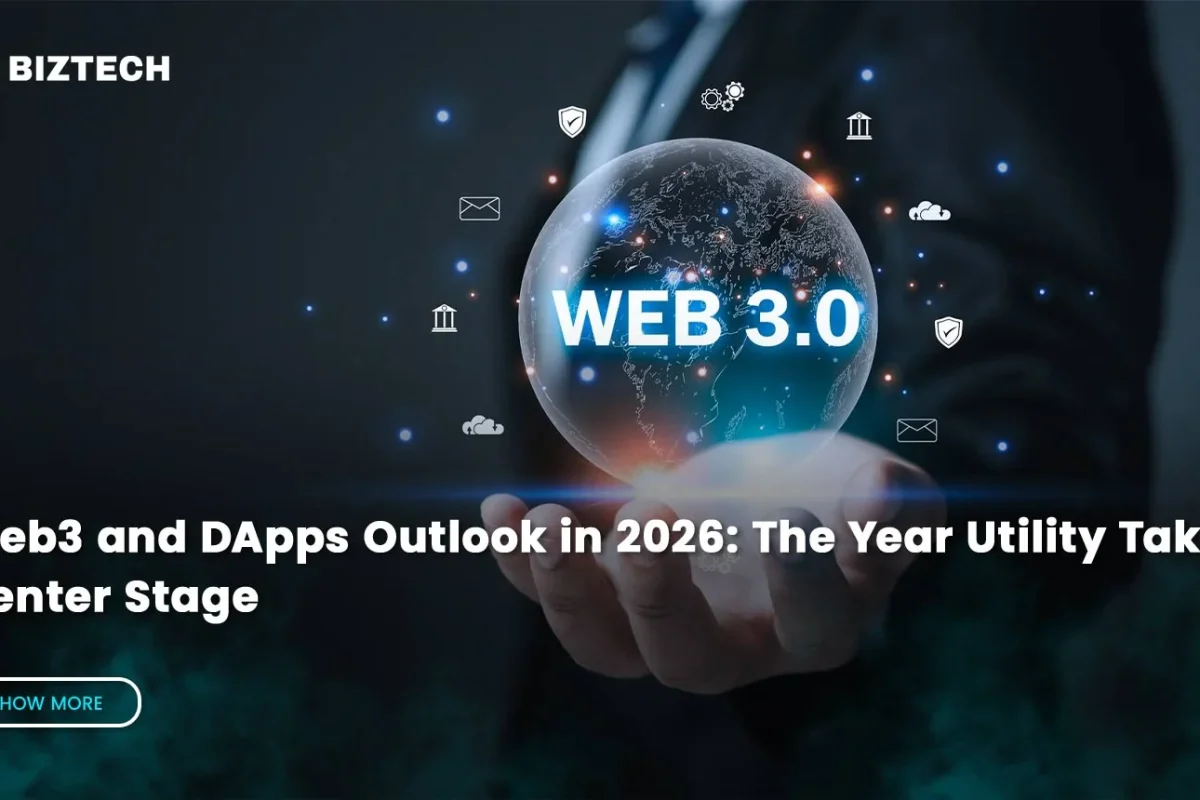
As we move into 2026, the cryptocurrency sector is moving away from constructing infrastructure and toward using it in the real world. Decentralized applications (DApps) have been growing networks, improving user experiences, and dealing with changing rules for years. Now they confront their biggest test: proving that they can be useful over time without relying on speculative incentives or token payouts.
There are no more crazy highs like the DeFi summers and NFT frenzies of the past. Instead, things are more stable now. Electric Capital’s annual report says that developer activity stayed the same in 2025, with a 5% gain in full-time contributions even though the total number of developers went down a little. This shows that the ecosystem is growing up and that dedicated builders care more about long-term relevance than short-term excitement.
The work done in 2025—better account abstraction, wallets that function on mobile devices, and clearer rules—sets the framework for 2026 to be a very important year. DApps now have to compete directly with Web2 heavyweights by making it easy for new users to join, keeping things simple, and giving users good reasons to come back every day. Success will depend on providing experiences that are more than just “on-chain.” This includes gaming and social networks, payments, and creative tools. The entire DeFi TVL is settling around $150 billion, and blockchain gaming is getting a lot of interest. The question isn’t whether Web3 can grow, but if DApps can keep customers after incentives are gone.
From Infrastructure to Application Maturity
Instead of tremendous growth, 2025 was a year of getting ready. The Fusaka upgrade to Ethereum made data more accessible and added zero-knowledge proofs. Solana and TON made mobile integrations even better. Account abstraction became almost the norm, which got rid of seed words for many users. Gas sponsorships made transactions feel free. Regulatory frameworks like the U.S. GENIUS Act and the EU’s MiCA set limits that encouraged innovation that followed the rules.
But this foundation showed a problem: Experiences that are broken up. There were thousands of individual DApps that needed their own logins, asset management, and learning curves, which made it hard to think. People moved their wallets between chains, bridged funds, and claimed airdrops. These actions were more motivated by rewards than loyalty. What happened? According to DappRadar, many apps have churn rates higher than 80% after an incentive.
2026 needs to come together. Super applications, which are all-in-one platforms that include payments, social media, gaming, and returns, are the answer. This is shown by Coinbase’s “everything app” strategy, Robinhood’s stock-crypto hybrid, and Kraken’s modular tools. TON’s combination with Telegram, which has 950 million users, gives it the best distribution. Base and Solana, on the other hand, focus on speed for consumers.
The Blockchain Gaming Alliance survey shows how this change is happening: Developers now care more about smooth gameplay and long-term ways to make money than token pumps. Web3 games need to be more enjoyable than Fortnite or Roblox, with blockchain coming in second. They should also have cross-game assets and AI-driven NPCs that distinguish them apart.
Key ecosystems ready to take over in 2026
Several chains will enter 2026 with different strengths that combine scalability, distribution, and use cases.
Ethereum is still the king of smart contracts, with $100 billion in TVL and the most developer interest. Fusaka’s blob expansions and ZK improvements make L2s cheaper and aim at 100,000+ ecosystem TPS. As rollups like Arbitrum and Optimism get older, common sequencing makes them less fragmented. Ethereum’s strength is that it can be used to build complicated DeFi and RWAs that are safe.
Solana fills the consumer need by making transactions happen in less than a second, which is perfect for mobile games and small payments. Its Saga phone and high-throughput (65,000 TPS) apps that are easy to use draw in people who don’t utilize crypto. In 2025, memecoin waves changed into utility plays, and enterprises like Pump.fun became creator platforms.
TON uses Telegram’s wide reach to make onboarding easy—Mini Apps brought in 500 million daily active users. Payments, games, and social all work together perfectly, making TON the Web3 version of WeChat.
According to DappRadar, BNB Chain has more than 6,000 DApps, making it the most popular chain because of its low fees and interaction with Binance. opBNB’s improvements are aimed at gaming and social finance.
New competitors like Monad (which can handle 10,000 TPS in parallel) and Abstract (which is consumer-focused and comes from Pudgy Penguins) are coming out with new ideas.
- Thematic winners: DePIN networks (Helium, Render) make money from real-world resources, while creator economies (Zora, FOMO) let people make money in ways other than advertisements.
- The Utility Imperative: Competing with Web2 DApps’ 2026 problem is to keep users without giving them reasons to do so. Web2 apps like Instagram and Uber are great at helping people create habits, and crypto has to do the same.
- Barriers are breaking down: Account abstraction (ERC-4337) lets you log in using social media accounts, send gasless transactions through sponsorships, and get finality on Solana/TON in less than a second. AI agents, which are self-driving on-chain actors, might do things like yield farming or minting NFTs, which would make DApps feel more active.
- Super applications combine: Think about a TON Mini App that lets you make payments, check social feeds, play games, and get yields—all in one place. Coinbase’s wallet is also changing, combining equities and cryptocurrencies. This cuts down on fragmentation fatigue, just like WeChat’s supremacy.
- Leads in gaming: The BGA survey puts gameplay ahead of tokens. Illuvium and Parallel are examples of projects that combine AAA quality with ownership. Players earn money through talent, not grinding.
- Social Fi grows up: FOMO’s leaderboard sharing and PNL transparency help build community, and Zora’s live creator tools let fans support creators directly.
- DeFi refines: Perpetual DEXs like Hyperliquid compete with CEXs in terms of transparency, while lending protocols use AI risk models to give possibilities with less collateral.
Some DApps won’t make it. Airdrops helped a lot of 2025 launches get off the ground, but 2026 shows off mediocre items. Regulatory differences (clear rules in the U.S. vs. restrictions in Asia) slow down expansion. User education is behind, and privacy concerns stay strong after data scandals.
But there are many good things with Stablecoins with a volume of $46 trillion make it easy to buy and sell, while ETFs with a volume of $175 billion make it easy for institutions to get involved. TVL might treble if 10% of Web2 users switch.
Final Thoughts
2026 is the year that Web3’s usefulness will be tested: Infrastructure gets better, but DApps need to show that they are useful every day. Ethereum’s ZK push, Solana/TON’s reach to consumers, and super applications like Coinbase’s mix offer smooth experiences. Gaming, Social Fi, and DeFi are in the lead, and they are fighting with Web2 on their own merits. To be successful, you need UX that makes people want to use it, models that last, and true value—not incentives. Electric Capital says that this concentration on builders could lead to breakthroughs. It’s not hype for crypto in 2026; it’s proof. Keep an eye on adoption indicators; the winners in utility will shape the next ten years.