Stay connected with BizTech Community—follow us on Instagram and Facebook for the latest news and reviews delivered straight to you.
The non-fungible token (NFT) market has changed a lot since 2021–2022, when people were mostly interested in making money off of them. Now, projects focus more on real-world use, developing communities, and cultural importance. The industry used to be known for its huge sales, as Beeple’s $69.3 million piece at Christie’s or a CryptoPunk selling for $23.7 million. Now, though, numbers and valuations are dropping quickly.
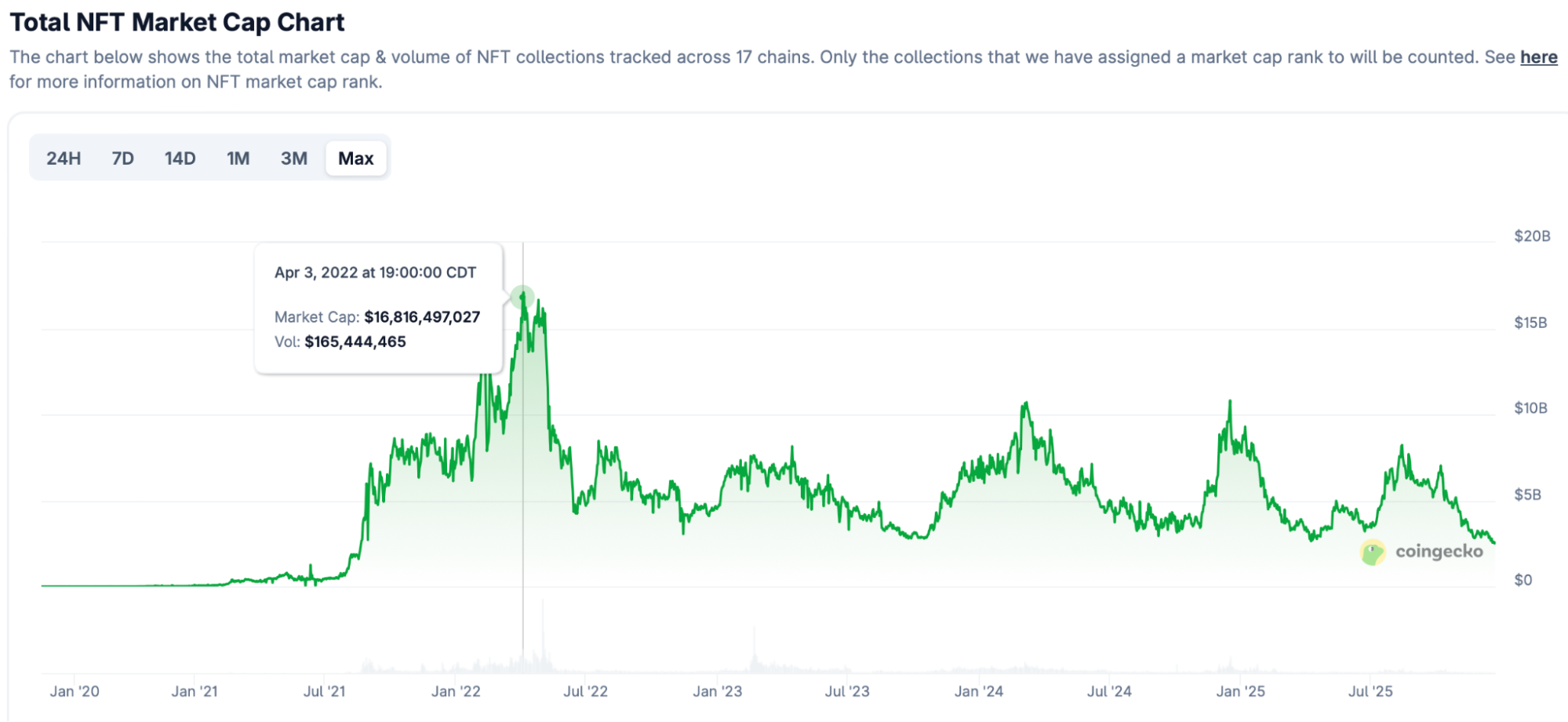
According to CryptoSlam data, sales in the first quarter decreased 63% from the same time last year to $1.5 billion. November was the worst month of the year, with sales of only $320 million. CoinGecko says the overall market cap has dropped to about $2.56 billion, which is more than 80% lower than its highest point in 2022. This cooling shows that the industry is evolving and that staying alive depends on providing real value instead of just price momentum.
However, in the midst of the decline, pockets of strength show how NFTs are changing. Blue-chip collections are being rethought as cultural artefacts, and new uses for blockchain in tickets, physical collectibles, and brand loyalty show how useful it can be. As 2025 comes to an end, the NFT space seems to be shedding its speculative veneer and becoming leaner and more focused on long-term value.
The Drop in Prices and Volumes
There has been a big drop in NFT trading activity since the start of 2025. Monthly sales volumes, which were above $1 billion in early 2024, fell below $400 million by the middle of the year and reaching their lowest point in November. This is very different from the boom from 2021 to 2022, when speculation drove trillions in total volume. Market cap numbers tell a similar story: The entire value of the sector has dropped to the low single-digit billions from highs of over $16 billion in 2022.
Even leading collections haven’t been safe. CryptoPunks, which has long been the standard for profile picture (PFP) projects, saw its floor price collapse 78% from its 2021 highs. However, a May 2025 IP transfer to the Infinite Node Foundation for cultural preservation helped keep things stable. With less interest from ordinary investors, Bored Ape Yacht Club and other comparable PFPs followed suit, with monthly drops of more than 10%.
There are many reasons why the slowdown is happening: Oversaturation from thousands of low-quality launches made demand less strong, regulatory scrutiny made speculation less appealing, and macroeconomic constraints, such high interest rates that lasted a long time, moved capital to safer assets. As cheap money dried up, fewer people participated in retail, leaving institutions and dedicated collectors to keep things going.
Change to NFTs that are useful
While pure digital art and PFPs had a hard time, NFTs that could be used in the real world became more popular. This change sees blockchain as infrastructure instead of the final product, which improves experiences with real goods, events, and loyalty.
Ticketing became a clear example of how to apply it. FIFA’s “Right to Buy” NFTs for the 2026 World Cup sold out immediately. They were priced at $999 for high-demand matches and gave fans priority access at face value to stop scalping. These tokens, made on sites like FIFA Collect, combine collectibility with usefulness, making sure fans get seats without having to pay extra on the secondary market.
Physical collectible tokenisation also did well. Courtyard.io, which specialises in vaulted Pokémon cards, did over 230,000 transactions in the last 30 days, bringing in $12.7 million in sales. Users trade verified cards as NFTs, and they can choose to have them delivered in person. “We use Web3 as a tool, not a destination,” says CEO Nicolas le Jeune. “The value lies in the underlying asset, with NFTs providing a better experience.”
Branded products and loyalty programs are two other specialisations. Luxury companies tokenised exclusive drops, while gaming integrations let objects in games move between different platforms. These apps show that NFTs can last when they solve genuine concerns like provenance, scarcity, and accessibility.
Repositioning Blue-Chips in Culture
Established collections changed by putting culture ahead of business. When Yuga Labs gave the CryptoPunks IP to a nonprofit foundation in May 2025, it characterised the project as digital legacy, keeping its standing as a pioneer outside economic concerns. Pudgy Penguins connected the digital and real worlds by selling toys on Amazon and Walmart. They made $72 million in NFT sales in the first quarter, a 13% increase over the same time last year.
This cultural focus makes sense in a time after the hype. Projects focus on community governance, real-life events, and long-term stewardship, which builds loyalty that lasts even when prices drop. As volumes go down, survivors construct moats around brand and utility, not short-term speculation.
A Quick Look at Market Data
CryptoSlam and CoinGecko make it obvious what the problems will be in 2025:
Sales in the first quarter were $1.5 billion, which is 63% less than the same time last year.
- Sales in November were $320 million, the lowest of the year.
- Market cap: about $2.56 billion, which is 66–80% lower than its peak.
- Physical-backed NFTs ($12.7M in 30 days for Courtyard) and ticketing (FIFA sellouts) are two areas that are doing well.
Video games and the metaverse NFTs kept some volume, but overall activity shows that the industry is consolidating.
What will happen to NFTs after 2025
The reset in 2025 cut out unnecessary speculation, providing a base for long-term growth. Utility-driven models, like ticketing, collectibles, and RWAs, are in line with the interests of institutions, as shown by BlackRock’s tokenised funds. The U.S. GENIUS Act and other clear regulations might speed up adoption, bringing RWAs to $2 trillion by 2028.
There are still problems: Lack of liquidity, significant obstacles to entry for people who don’t use crypto, and competition from centralised apps. Success depends on smooth onboarding and value that has been shown.
In 2025, NFTs went from being a speculative boom to becoming useful and part of culture. Volumes fell sharply, but survivors like Pudgy Penguins and Courtyard did well by connecting digital tokens to real-life events. FIFA’s ticketing and physical memorabilia show how useful blockchain may be. Prices may go down, but significance stays the same. NFTs are not dead; they are changing into tools for authenticity, access, and community in a world that is becoming more digital. For 2026, expect further growth: Less talk, more action.