Stay connected with BizTech Community—follow us on Instagram and Facebook for the latest news and reviews delivered straight to you.
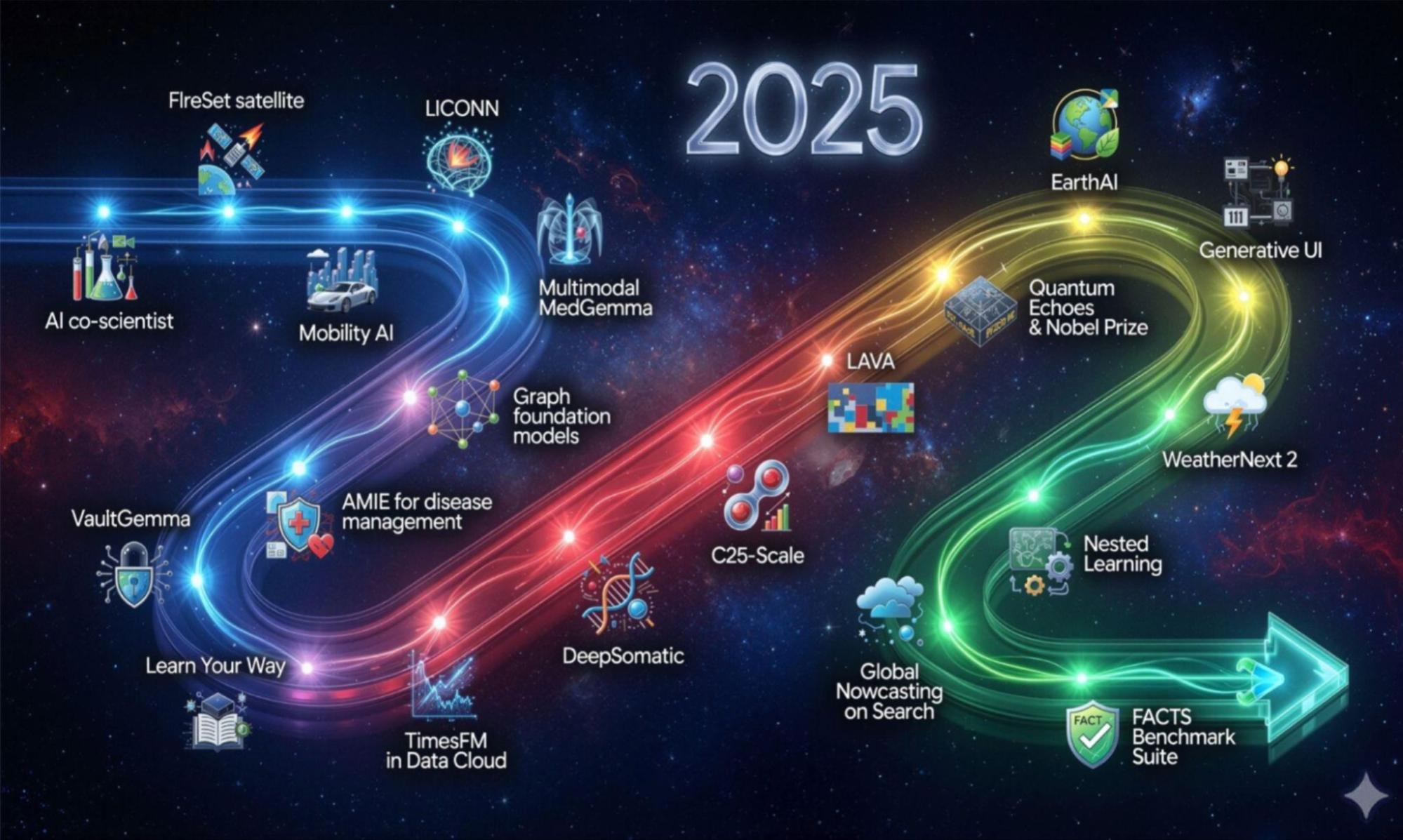
Google has released a detailed recap of its artificial intelligence research advancements in 2025, outlining 60 key announcements that highlight the company’s progress in models, products and applications. The blog post, published on Monday, frames the year as one where AI evolved from experimental technology to a core driver of innovation, impacting billions through enhanced reasoning, multimodality and efficiency.
The summary emphasises Google’s focus on responsible development, collaboration and real-world applications, positioning AI as a tool for societal benefit. “In 2025, we made significant AI research breakthroughs with models like Gemini 3 and Gemma 3,” the post states, crediting these for improvements in reasoning, multimodality, efficiency and creative abilities.
World-Class Models and Technical Advances
Central to the recap is the Gemini series. Gemini 3 Pro, launched in November, emerged as Google’s most powerful model, topping the LMArena Leaderboard and achieving breakthrough scores on Humanity’s Last Exam and GPQA Diamond benchmarks. It set a new standard in mathematics with 23.4% on MathArena Apex. Gemini 3 Flash, released in December, offers Pro-grade reasoning with low latency and cost, surpassing previous Gemini 2.5 Pro capabilities.
Gemma 3 models added multimodal capabilities, larger context windows, multilingual support and efficiency, making them runnable on single GPUs or TPUs. These advancements enabled better handling of complex tasks, from coding to long-context analysis.
Product Innovations and Creativity Tools
AI transformed Google’s products, with agentic systems like Gemini 3’s coding capabilities and Google Antigravity for AI-assisted software development. Pixel 10 features AI-enabled tools; Search introduced AI Mode and expanded AI Overviews; the Gemini app gained upgrades; NotebookLM added Deep Research. These integrations reimagined developer collaboration and enhanced user experiences.
In generative media, models like Nano Banana and Nano Banana Pro enabled native image generation and editing. Tools such as Flow, Music AI Sandbox, Veo 3.1, Imagen 4 and Flow advanced video, images, audio and virtual worlds. Google Labs experiments included Pomelli for marketing, Stitch for UI design, Jules for coding and Google Beam for 3D video, expanding creative workflows.
Science, Mathematics and Global Challenges
AI advanced life sciences with AlphaFold’s impact, used by over 3 million researchers in 190+ countries; DeepSomatic for tumour variants; AlphaGenome for genome understanding. In math and coding, Gemini with Deep Think achieved gold-medal standards in the International Mathematical Olympiad and International Collegiate Programming Contest.
Read also this: TIME Names ‘Architects of AI’ as 2025 Person of the Year
For global issues, AI-enhanced weather forecasting with WeatherNext 2 (8x faster, high-resolution); flood warnings for 2 billion people in 150 countries; Google Earth AI for geospatial mapping; FireSat for wildfires. In health, Gemma models discovered cancer therapy pathways; AMIE for disease management. Education tools like LearnLM and Guided Learning expanded career and learning support.
Computing, Physical World and Responsibility
Quantum progress included Quantum Echoes for real-world applications and a Nobel Prize for Googler Michel Devoret. Ironwood TPU, designed by AlphaChip, focused on inference efficiency. Gemini Robotics 1.5 and Genie 3 advanced AI agents in physical and virtual worlds.
Responsibility efforts included comprehensive safety evaluations for Gemini 3, AI image/video verification, strengthened Frontier Safety Framework and a path to responsible AGI. Collaborations formed the Agentic AI Foundation for open standards, partnering with the U.S. Department of Energy, universities and schools for AI skills and research.
The post concludes optimistically: “As we look towards 2026, we’re looking forward to continuing to advance the frontier, safely and responsibly, for the benefit of humanity.”
This recap arrives amid broader AI reflections, reinforcing Google’s leadership while highlighting collaborative needs in a competitive field.