Stay connected with BizTech Community—follow us on Instagram and Facebook for the latest news and reviews delivered straight to you.
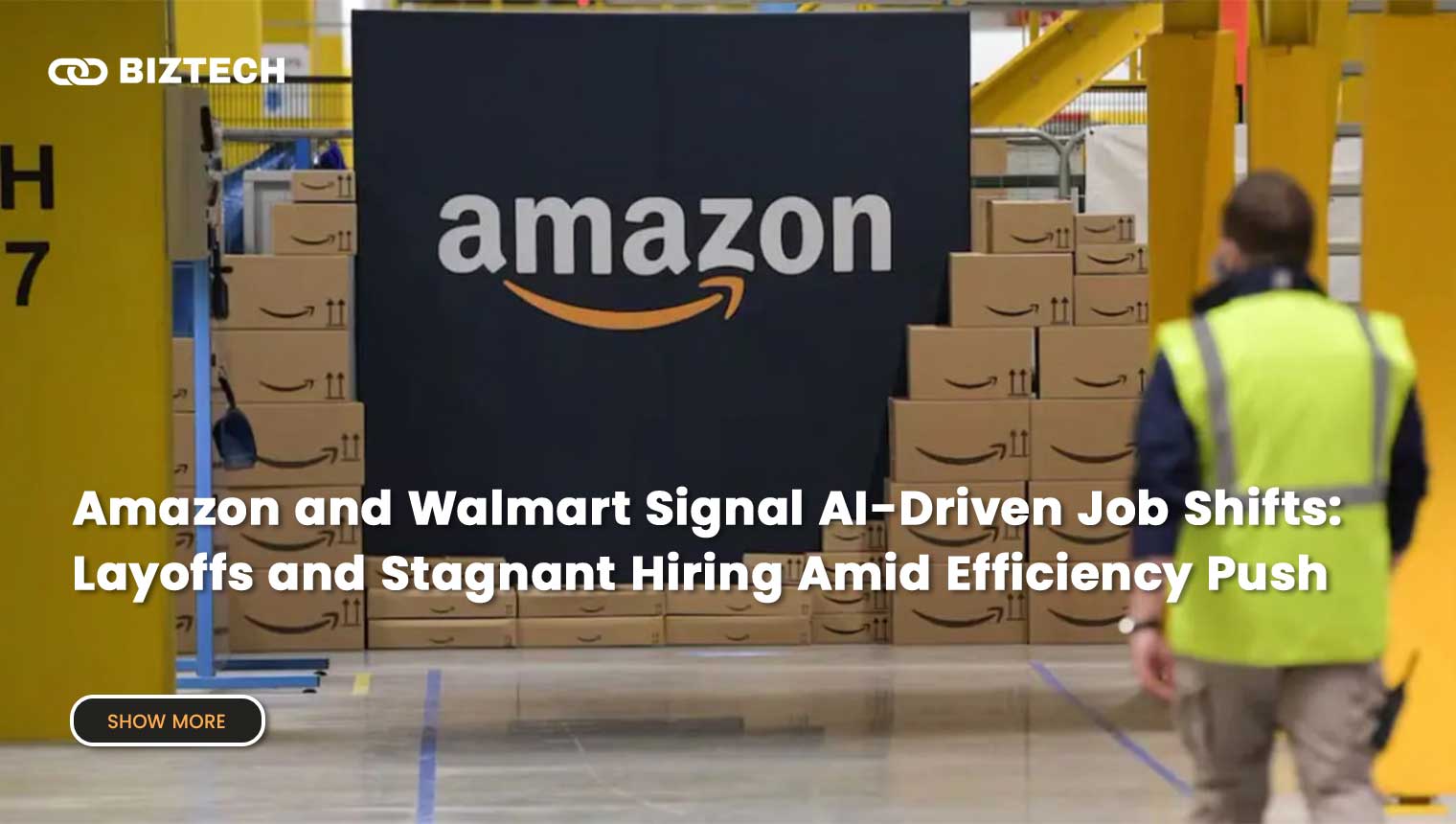
Two of the world’s largest retailers, Amazon and Walmart, have disclosed plans for significant workforce reductions and hiring freezes, attributing the moves to the integration of artificial intelligence and automation technologies. Amazon revealed it would eliminate up to 14,000 corporate positions as part of a broader efficiency initiative.

At the same time, Walmart indicated its headcount would remain flat for the foreseeable future, citing AI’s role in reshaping operational roles. These developments highlight the accelerating impact of AI on employment in the retail sector, raising questions about the pace of technological disruption and the need for workforce reskilling.
The disclosures come amid a turbulent period for the tech and retail industries, where over 100,000 job losses have been reported in 2025, often linked to AI adoption rather than economic downturns. Amazon’s cuts, affecting its 1.6 million-strong global workforce, target administrative and support functions, with the company emphasising that AI tools are enabling “more efficient processes” in areas like inventory management and customer service. Walmart, employing over 2.3 million in the US alone, described its stance as a “strategic pivot,” with AI-powered systems handling tasks previously performed by staff, such as predictive stocking and personalised recommendations.
Automation’s Reach in Retail Operations
Amazon’s efficiency drive builds on its long-standing investments in robotics and machine learning. The company has deployed over 750,000 robots in its fulfilment centres, with recent AI enhancements automating quality control and demand forecasting. Executives noted during an earnings call that these technologies have reduced operational costs by 15% year-on-year, allowing for reinvestment in growth areas like cloud computing and advertising. However, the layoffs—concentrated in Seattle and other tech hubs—have drawn criticism from labour groups, who argue that the pace of change outstrips support for affected workers.
Read also: Google Launches Veo 3.1: Advancing AI Video Generation with Audio Integration
Walmart’s approach is similarly proactive. The retailer has expanded its use of AI through partnerships with Microsoft and Google, implementing computer vision for shelf monitoring and natural language processing for employee queries. In a memo to staff, Walmart’s chief people officer stated that while total headcount would stabilise, opportunities in AI oversight and data analysis roles would expand. This aligns with a broader industry trend: A recent McKinsey report estimates that AI could automate up to 45% of retail activities by 2030, displacing routine jobs but creating demand for specialised skills.
The announcements follow a pattern seen across Big Tech, including Meta’s 10% workforce reduction earlier this year and Google’s AI-focused restructuring. In the US, where retail employs 52 million people, these shifts could exacerbate income inequality if reskilling programmes lag. The Biden administration has responded with proposals for a $500 million AI workforce fund, aimed at training displaced workers in digital literacy and prompt engineering.
Global Ramifications and Calls for Adaptation
Internationally, the news has prompted varied reactions. In the UK, where Amazon and Walmart (via Asda) operate extensively, trade unions have urged mandatory AI impact assessments, echoing EU directives under the AI Act. China’s e-commerce giants, such as Alibaba, face similar pressures but report smoother transitions through state-backed vocational programmes. Economists warn that without intervention, AI-driven disruptions could slow consumer spending, a key driver of global GDP.

As November’s economic indicators emerge—amid IMF forecasts of 3.2% global growth tempered by tech volatility—these retail giants’ strategies underscore AI’s dual-edged sword: a catalyst for innovation and a vector for upheaval. Policymakers and businesses alike must prioritise equitable transitions to harness its benefits. For workers navigating this landscape, the message is unequivocal: Adaptation is no longer optional.