Stay connected with BizTech Community—follow us on Instagram and Facebook for the latest news and reviews delivered straight to you.
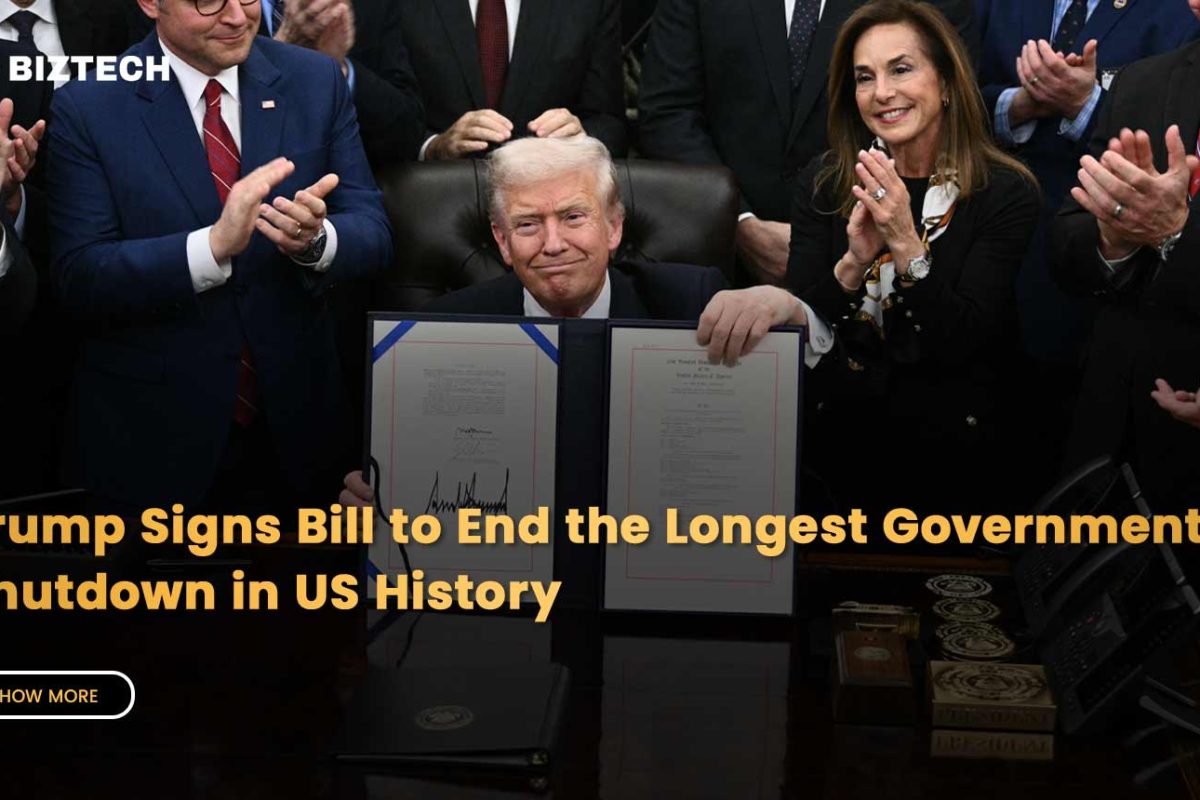
On November 13, 2025, President Donald Trump signed a bipartisan financing deal that ended the longest federal government shutdown in American history. The bill restored agencies and gave back pay to hundreds of thousands of furloughed workers. The action occurred after weeks of tough talks.
It stopped the crisis from doing more damage to the economy, which had already cost the U.S. economy an estimated $20 billion and messed up everything from airport security to food assistance programs. The settlement gave the cryptocurrency market a cautious boost, with Bitcoin rising back above $102,300 and the total crypto market cap rising back to $3.45 trillion.
The shutdown, which started on October 1 because of disagreements over funding and spending priorities for border security, lasted 43 days, breaking the previous record of 35 days established during Trump’s first term in 2018-2019. It stopped paying 800,000 federal workers, stopped non-essential services, and pushed back the reporting of important economic data like non-farm payrolls. The resolution not only brings things back to normal, but it also opens the door for a renewed focus on fiscal policy, which will have an effect on interest rates and asset markets, including digital currencies.
The Road to Resolution
It was challenging to get the bill passed in a Congress that was split. The House of Representatives voted 222 to 209 to pass the bill on November 12. Six Democrats joined the Republican majority in supporting it. Two Republicans voted against it, showing that there are still divides. Earlier that week, the Senate had passed a similar bill. Eight Democrats joined Republicans to overcome a filibuster and speed up the process.
House Speaker Mike Johnson brought members back from their break on September 19 to deal with the deadlock. He dubbed the result a “necessary compromise” to keep important services running.
The package has three financial laws that keep the government running until September 2026, with a short-term extension for some agencies until January 30, 2026. Key parts make sure that furloughed workers get back pay, protect against layoffs until the end of January, and properly finance programs like the Supplemental Nutrition Assistance Program (SNAP), which helps over 40 million low-income Americans and was disrupted during the shutdown.
Trump had promised not to sign any bill that didn’t include more money for the border wall, but he gave in when business leaders, unions, and even his own party put more and more pressure on him. He called the accord “a win for American workers and security” at a signing ceremony in the Rose Garden, but he again criticized Democrats for the delay. The compromise stops a possible debt ceiling crisis, but with the national debt above $36 trillion, fiscal hawks say there will be more fights in the future.
The Shutdown’s Effect on the Economy
The 43-day deadlock hurt the U.S. economy a lot. The Congressional Budget Office says that missed productivity, postponed contracts, and less consumer spending cost the economy $18 billion.
Federal employees missed two paychecks, which caused long lineups at food banks and late mortgage payments. In the aviation industry, for example, 10,000 TSA screeners called in sick, which delayed flights at major airports. National parks had $500 million in repair backlogs, while 60 million taxpayers had to wait for their IRS returns.
The shutdown had ramifications on the financial markets, as uncertainty made things even more volatile. In October, stock indices like the S&P 500 fell by 5% because investors were worried about delayed economic data that made it hard for the Fed to make decisions. Crypto, which is frequently a sign of how people feel about risk, took the worst of it: On October 10, Bitcoin fell below $101,000 because of rising tariffs. It lost $19 billion in liquidations, the most ever, which wiped out leveraged longs. The whole market cap decreased 8% to $3.78 trillion. Ethereum declined 12% to $3,800, and altcoins like Solana and XRP fell 14% and 12%, respectively.
But the resolution gave people hope, Bitcoin went back up 3% to $102,300 in a few hours, Ethereum went up to $3,500, and BNB/SOL went up 1%, bringing the market cap back to $3.45 trillion.Some analysts say this is because budgetary risks have gone down and the Fed is expected to drop rates. CME FedWatch gives a 95% chance of a 25 bps cut in November.
The Shutdown Saga of Crypto
The shutdown’s data blackout, which delayed NFPs and CPI, made crypto prices even more volatile because traders didn’t have any macro indications.
The drop in October, which was caused by tariffs in response to China’s restrictions on rare earths, made them even more worried about a long period of uncertainty. But crypto’s decentralized nature made it strong. Stablecoins like USDT handled $46 trillion in transactions in 2025, even if fiat currencies were having problems. Bitcoin’s scarcity story stood out even more since people were worried about its value dropping.
Trump’s support for cryptocurrencies, such pardoning CZ and promoting stablecoin laws, helped the recovery: After the signing, attitude indexes changed to “greed” (74 out of 100), and ETF inflows were close to $1 billion a week. “Shutdown over—crypto breathes relief,” tweeted @CryptoWhale, as BTC looked to break through the $106,000 barrier.
Lessons for the Long Term
With $1.8 trillion in deficits and $36 trillion in debt, this unprecedented shutdown shows how weak America’s finances are. For crypto, it shows its attraction as a hedge—gains during chaos—but it also shows the risks of using leverage, since $19 billion in liquidations hurt traders. As the markets settle down, the settlement makes it easier for the Fed to ease up, which may raise the price of BTC to $125,000 by the end of the year.