
Stay connected with BizTech Community—follow us on Instagram and Facebook for the latest news and reviews delivered straight to you.
MicroStrategy Inc. (MSTR), a company that used to make corporate software but is now a huge Bitcoin treasury, is facing a risky future on the stock market. A recent report from JPMorgan Chase says that the business’s huge holdings in bitcoin could have it kicked out of important U.S. equities indices.
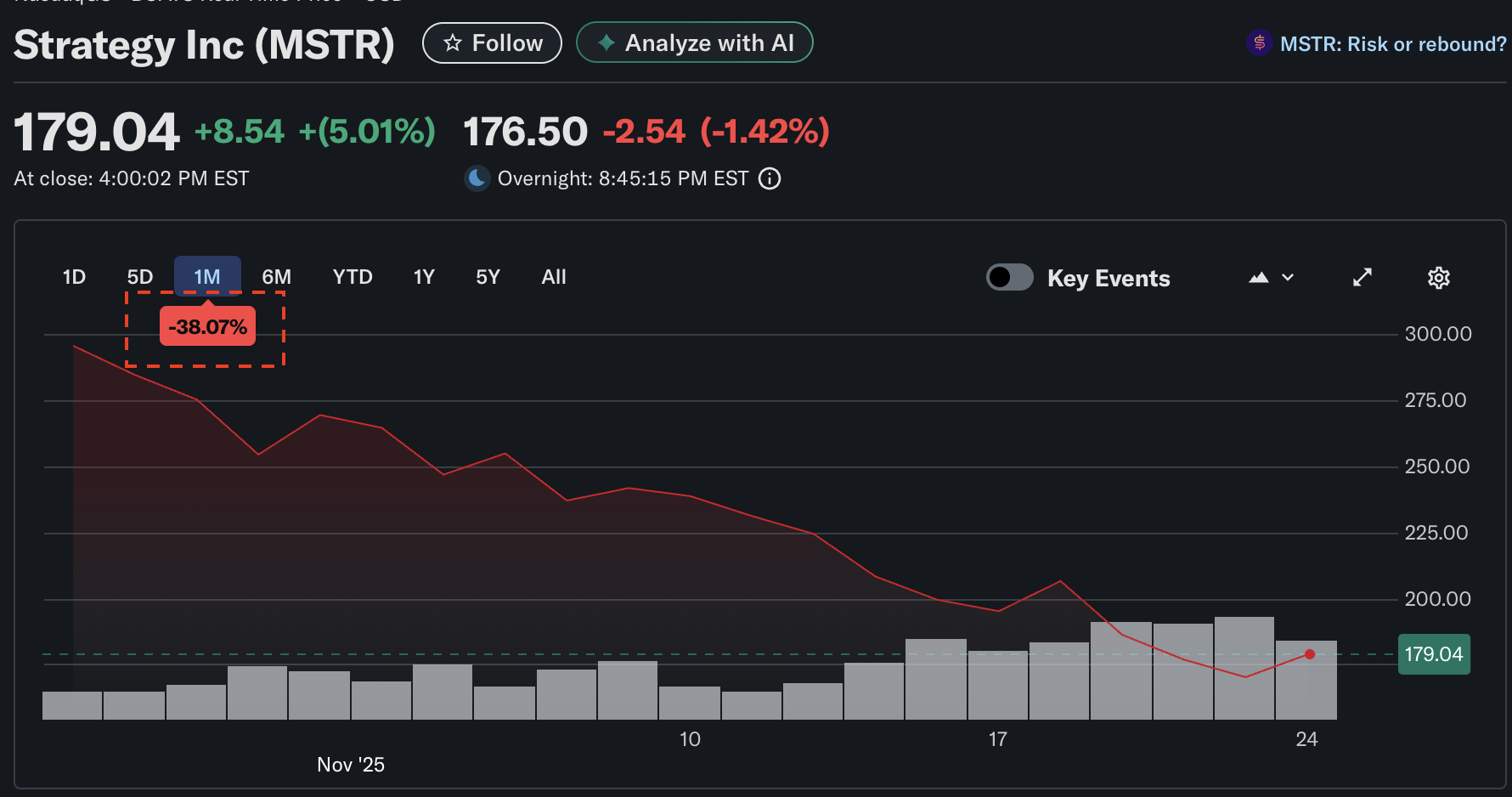
This could cause billions of dollars to flow out of passive funds and make it much harder for the company to raise money. MSTR’s stock has already taken a hit, falling more than 40% in the previous month because of problems in the broader market. The danger of being left out of an index adds to the uncertainty for investors who have long used the shares as a way to have exposure to Bitcoin.
Bloomberg’s story from November 20, 2025, shows how weak MSTR is since its value is becoming more and more linked on its 649,870 BTC stockpile, which is worth about $55 billion at current pricing. JPMorgan thinks that just being removed from the MSCI USA Index may cause passive funds to sell $2.8 billion worth of stocks, and if the Nasdaq 100 and Russell 1000 do the same, the total amount of money that leaves might reach $11.6 billion. There are about $9 billion in passive assets that follow MSTR shares right now, which makes it a big holding for ETFs and index trackers.
That day, MSTR shares, which are quite similar to BTC shares, finished at $177.13. This was a 5% reduction for the day and a 40% drop over the month, which is much more than Bitcoin’s 22% drop. The premium that MSTR trades at compared to its underlying Bitcoin holdings has disappeared. If index adjustments happen, the stock could go down even more.
The Index Exclusion Threat MSCI
One of the world’s largest index providers is exploring ways to exclude corporations from its benchmarks if their crypto assets make up more than 50% of their overall holdings. A decision is scheduled for January 15, 2026, following a consultation period that ends in December. For MSTR, where Bitcoin makes up more than 90% of its balance sheet, the condition would be a death sentence.
Under CEO Michael Saylor, the company has changed from a small software supplier to a de facto Bitcoin investment vehicle. Since 2020, Saylor has actively bought BTC utilizing debt and stock raises.
Reggie Smith, an expert on regulations at JPMorgan, says such exclusion would require passive managers like Vanguard and BlackRock, which own $9 billion in MSTR, to rebalance by selling a large number of shares at once.
Smith said, “MSTR’s index status has been a key driver of its liquidity and valuation premium.” “Being left out could make the discount to NAV worse, making it harder to raise money in the future and pushing the stock closer to single digits.”
The Nasdaq 100 and Russell 1000 are both under comparable examination. Nasdaq’s rules stress “representative” constituents, and MSTR’s focus on crypto could make it too risky to be included. Russell’s annual reconstitution in May 2026 might speed things up if early screens indicate a problem. The combined effect might be like Tesla’s entry to the index in 2010, which brought in $10 billion, but in the other direction.
MSTR’s response has been typically positive. Saylor, a well-known Bitcoin maximalist, tweeted on November 21: “Indices come and go; Bitcoin stays.” We’re not making changes every three months; we’re building for the long haul. The business, which had a $1.2 billion unrealized BTC gain in the third quarter even while its core software sales were flat, is sticking to its plan to reach 1 million BTC by 2030.
How Bitcoin Affects MSTR’s Volatility
Bitcoin’s price, which closed at $85,702 on November 21, down 6.8% for the day and on course for an 8% weekly loss, is closely related to MSTR’s future. The cryptocurrency’s drop was caused by a disappointing September jobs report, which showed only 119,000 new positions instead of the expected 150,000 and an unemployment rate of 4.4%. This made it harder to predict a Fed decrease. Futures now give a 75% chance of a 25-bps cut on December 25, down from 90%, according to CME FedWatch.
This macro backdrop has made MSTR’s agony worse: The stock is trading at a 1.2x premium to its Bitcoin NAV, which is the lowest level since 2022. This is because investors are unsure about the long-term viability of Saylor’s leveraged acquisition plan. With $4 billion in convertible debt due in 2027, not being included in indices could make borrowing more expensive, which could force sales during bad times. JPMorgan says that if outflows make the discount worse, there might be a “death spiral.”
But some people see a chance. They pointed out that the stock’s 55% decrease over the past six months is slightly less than Bitcoin’s 22% drop from $126,000 in a month. Institutional investors like ARK Invest, which has $1.5 billion in MSTR, are still holding on to it because they see it as a way to get more exposure to crypto.
The broader market perspective
Bitcoin’s problems go beyond MSTR: The asset’s 22% drop from $126,000 in early October to $98,000 in late October is due to worries about tariffs, a stronger currency (DXY up 2%), and delayed data because of the shutdown. Ethereum ($3,450, -5.2%) and Solana ($138, -7.1%) followed suit, as the market cap fell 4.3% to $3.78 trillion.
MSTR’s problems are similar to those of crypto as it grows: Bitcoin ETFs have grown to $175 billion, and corporate treasuries like Tesla’s $1.35 billion BTC (up $80 million in Q3) are doing well. However, pure-play companies like MSTR are under scrutiny. The SEC’s 2025 fair-value regulations make things more volatile, turning unrealized gains into earnings swings.
Conclusion
JPMorgan’s warning that MSTR could be delisted could lead to $11.6 billion leaving MSCI, Nasdaq, and Russell, putting the Bitcoin proxy’s life in danger because its 649,870 BTC ($55 billion) position is larger than a $9 billion passive stake.
Shares are down 40% this month to $177.13, and the January 15 MSCI call might start a downward spiral, but Saylor still believes in it. With BTC’s price drop to $85K and a cloudy macroeconomic picture, MSTR’s future pushes the limits of corporate crypto: is it a chance or too much exposure? Watch for rebalances; the next leg of the stock market depends on the index.